
Hidden Infrastructure, Visible Impact: CPayant Releases H1 2026 Cross-Border B2B Metrics
By Emmanuel Tokunbo Darko, CEO of CPayant.
The global conversation surrounding digital assets is often plagued by a fundamental misunderstanding of what businesses actually need. While tech evangelists celebrate the theoretical benefits of the blockchain, the reality on the ground is that 95% of cross-border merchants care nothing about stablecoins, crypto, or blockchain protocols.
They care about survival. They care about liquidity. They care about moving money fast enough to keep their supply chains from collapsing.
At CPayant, we built our platform on a core philosophy: Infrastructure should be invisible. Our users interact with CPayant exactly as they would with a premium local banking app, managing transactions in US Dollars (stables) and seeing the local currency equivalent, completely unaware of the complex rails moving beneath the surface.
As we wrap up the first half of 2026, we are pulling back the curtain on our internal metrics to show how invisible, stablecoin-native plumbing is powering real-world B2B trade across Africa and into major global corridors.
1. The Power of Choice: Why We Built on USDC
Because our users do not choose the underlying asset, the burden of selecting the safest, most efficient settlement vehicle falls entirely on us. During H1 2026, CPayant’s internal transaction engine was heavily anchored by USD Coin (USDC).
● USD Coin (USDC): 90%
● Tether (USDT): 10%
A staggering 90% of our backend transaction volume was settled via USDC, with Tether (USDT) accounting for the remaining 10%.
Our reliance on USDC is a deliberate strategic choice. It is partly rooted in our history; early grant support from Circle provided vital ecosystem momentum, inspiring an enduring alignment with their institutional-grade framework. Beyond loyalty, USDC delivers the strict regulatory compliance, transparent auditing, and direct institutional banking access required to move millions of dollars securely out of Africa and into global markets. Our users simply see a seamless transaction; we handle the institutional security in the background.
2. Intra-African Corridors: High-Velocity Retail and B2B Depth
By abstracting away the blockchain, we have been able to map our digital engine directly onto the payment methods merchants already use daily: mobile money networks, commercial banks, and modern digital platforms.
A. The Heavyweight: Ghana↔Nigeria (60% of Total Intra-African Frequency)
This lane is our highest-velocity corridor, capturing over half of all intra-African transaction frequency from January to June.
● Directional Flow: Transactions are heavily weighted in one direction, with 67% of payments moving from Ghana to Nigeria, and Nigeria to Ghana absorbing the remaining 33%.
● The Ghana Deposit Engine: In terms of daily frequency, 90% of deposits in Ghana originate via Mobile Money (MoMo). However, because CPayant’s corporate and B2B strength in Ghana is exceptionally deep, 90% of total monetary volume deposits move via traditional bank transfers, capturing large-scale trade settlements.
● The Nigeria Outbound Payouts: When clearing funds into Nigeria, digital-first infrastructure dominates. 75% of payouts go directly to Neo-banks (such as OPay, Moniepoint, and PalmPay), while the remaining 25% go to legacy traditional banks.
● The Nigeria Deposits: For capital originating from Nigeria, deposit frequency is split 50/50 right down the middle between neo-banks and legacy institutions like GTBank, UBA, and Zenith Bank.
B. The East African Bridge: Ghana→Kenya
● Directional Flow: An overwhelming 97% of transactions move from Ghana to Kenya.
● Payout Infrastructure: Kenya’s mobile money ecosystem remains unmatched; 95% of our outbound payouts settle instantly into M-Pesa, with only 5% routing to Kenyan commercial banks.
C. The Central-to-West Pipeline: Cameroon→Nigeria
● Directional Flow: A pure, one-way trading lane on our platform, with 100% of transactions moving from Cameroon to Nigeria.
● Rail Dynamics: This lane perfectly bridges informal and formal sectors, featuring 100% mobile money deposits from Cameroon clearing into 100% traditional bank payouts in Nigeria (Zenith Bank, GTBank, UBA, and Access Bank).
D. The Ecosystem Play: Uganda→Ghana
● Directional Flow: Primarily dominated by capital moving from Uganda to Ghana.
● Network Effects: In Uganda, 100% of deposits originate via mobile money. Most notably, this corridor has become a hub for deep network lock-in: 80% of Ugandan users pay directly into another CPayant user’s account, creating a seamless, closed-loop business network.
3. Outer Corridors: Sourcing From Asia, Capitalizing in the West
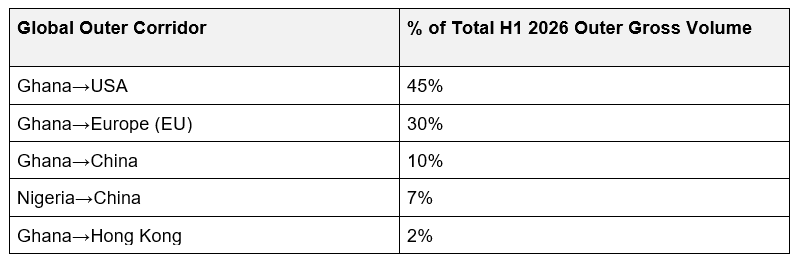
Our global data shows a clear economic split. Asian corridors dominate day-to-day transaction frequency (the heartbeat of small-business inventory sourcing), while Western corridors (the US and Europe) absorb massive institutional gross dollar volume.
Outer Corridor Transaction Frequency (Where Businesses Pay Most Often)
When African merchants source goods regularly, Asia is the primary focus:
- Ghana→China: 50% of outer corridor frequency.
- Nigeria→China: 15% of outer corridor frequency.
- Ghana→Hong Kong: 5% of outer corridor frequency.
- Ghana→USA: 5% of outer corridor frequency.
Outer Corridor Gross Volume (Where the Largest Capital Moves)
The most glaring vulnerability of traditional cross-border commerce is the settlement freeze. Under legacy banking systems, an international SWIFT wire transfer takes 3 to 5 business days to clear, trapping working capital and leaving merchants exposed to severe local currency volatility.
By running our stablecoin architecture silently in the background, CPayant has completely rewritten the industry standard for speed.
● Intra-African Rails: For cross-border transactions moving entirely within the African continent, our backend infrastructure has achieved an incredible average settlement time of less than 57 seconds.
● Global Outer Corridors: For capital moving to global destinations like China, the US, and Europe, our customer-facing service-level agreement (SLA) conservatively promises a window of 1 to 18 hours. However, through deep liquidity routing and optimized transaction tracks, our actual performance data reveals we have averaged less than 30 minutes for global settlements so far this year.
Whether a business owner is paying a regional supplier across the border or clearing an invoice to an international manufacturer, the capital moves, clears, and settles in a fraction of the time required by traditional financial networks.
Closing Thoughts: The Future of Fintech Is Invisible
What our H1 2026 data proves is that the most successful innovations do not force users to adapt to new technology; they adapt the technology to the user.
By marrying the familiarity of mobile money and traditional bank apps with the invisible speed of a USDC-driven backend, CPayant has built a global trade bridge that just works. We enter the second half of 2026 focused on deepening these corridors, expanding our institutional partnerships, and ensuring that any African business can trade globally without ever needing to understand the complexity of the rails that make it possible.
Ready to expand your business across Africa?
Join thousands of SMEs already using CPayant for seamless cross-border payments.